In this section, you will first learn to find out what day, month and season it is. You will then learn how to talk about the weather.
When you want to find out what day it is, you can ask someone:
¿Qué día es hoy? (What day is it?) Hoy es lunes. (Today is Monday.) Hoy es martes. (Today is Tuesday.)
When you want to find out what day tomorrow is, you could ask:
¿Qué día es mañana? (What day is tomorrow?) Mañana es jueves. (Tomorrow is Thursday.) Mañana es viernes. (Tomorrow is Friday.)
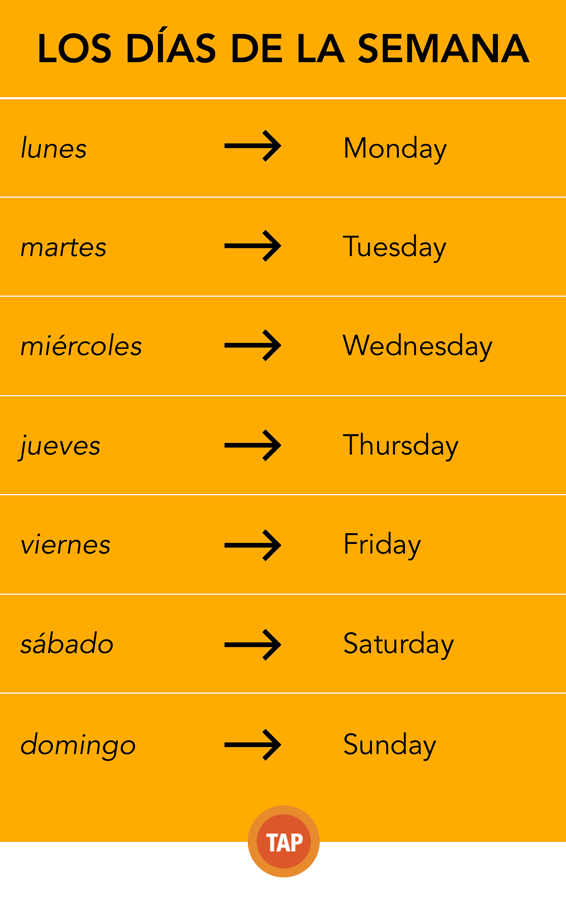
Here is a list of the days of the week:
If you want to find out in what month someone’s birthday falls, you could ask:
¿En qué mes es su cumpleaños? (In what month is your birthday?) Mi cumpleaños es en agosto. (My birthday is in August.) Mi cumpleaños es en noviembre. (My birthday is in November.)
If you want to ask someone which season is his or her favorite, you could ask:
¿Qué estación le gusta más? (What season do you like best?) Me gusta más la primavera. (I like the spring best.) Me gusta más el verano. (I like the summer best.) Me gusta más el otoño. (I like the fall most.) Me gusta más el invierno. (I like the winter most.)
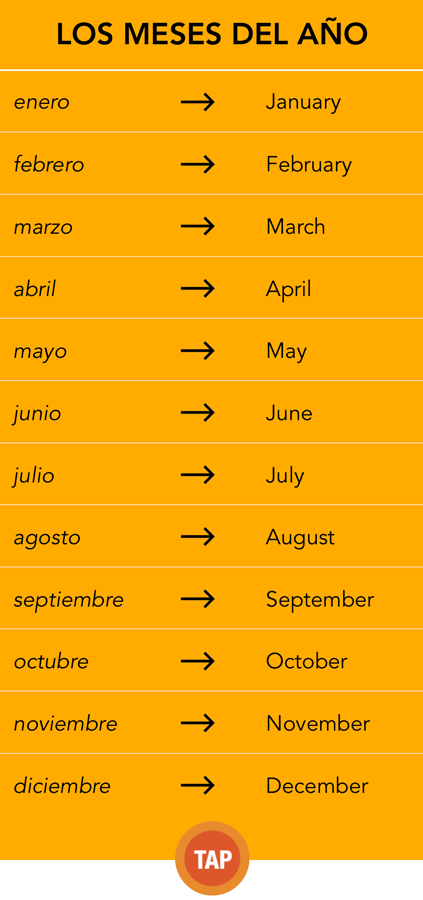
Here is a list of the months of the year:
When you want to find out what the weather is like, you can ask someone:
¿Qué tiempo hace hoy? (How’s the weather today?) Hace frío. (It’s cold.) Hace calor. (It’s hot.)
If it is particularly hot or cold, a person might respond:
Hace mucho frío. (It’s very cold.) Hace mucho calor. (It’s very hot.)
Here are a few common expressions that describe the weather:
33427
PRÁCTICA DE PRONUNCIACIÓN
Here are two more consonants:
j
The Spanish “j” has a rather harsh sound, kind of like an English “h” that got caught in the back of your throat. At times, it sounds as if one were clearing one’s throat. jota, jamón, rojo, reloj, jaca, lejos, junio, julio, jarabe, justos
g
The “g” is pronounced in two different ways. As in English, when a “g” comes before an “a,” “o,” or “u,” it sounds just like the “g” in “goose.” gota, gozar, lago, Gutiérrez, gato, lúgubre, Galicia, gobierno
Note: The groupings “gui” and “gue” are pronounced in Spanish in a special way. The “u” sound in both of these combinations is completely silent. The purpose of the silent “u” is to make the “g” sound like the one in “goose.”
guitarra, guerra, guisar, llegue, merengue, guisado, guiñar, sigue When a “g” is before an “e” or an “i,” however, it sounds just like the “j” described above. gente, gitano, gesto, girar, ágil, generoso, general