If you want to learn about someone’s family, you might ask him or her:
¿Tiene Ud. (usted) hermanos? (Do you have brothers and sisters?) Sí, tengo un hermano. (Yes, I have one brother.) Sí, tengo una hermana. (Yes, I have one sister.) No, no tengo hermanos. (No, I don’t have brothers or sisters.)
¿Tiene Ud. (usted) abuelos? Do you have grandparents?) Sí, tengo un abuelo. (Yes, I have one grandfather.) Sí, tengo una abuela. (Yes, I have one grandmother.) No, no tengo abuelos. (No, I don’t have grandparents.)
You might want to ask someone about another person’s family. If so, you could ask:
¿Tiene María hermanos? (Does Mary have brothers and sisters?) Sí, María tiene un hermano. (Yes, Mary has a brother.) Sí, María tiene una hermana. (Yes, Mary has a sister.) No, María no tiene hermanos. (No, Mary doesn’t have brothers or sisters.)
¿Tiene su amigo muchos primos? (Does your friend have many cousins?) Sí, mi amigo tiene muchos primos. (Yes, my friend has many cousins.) No, mi amigo no tiene muchos primos. (No, my friend doesn’t have many cousins.)
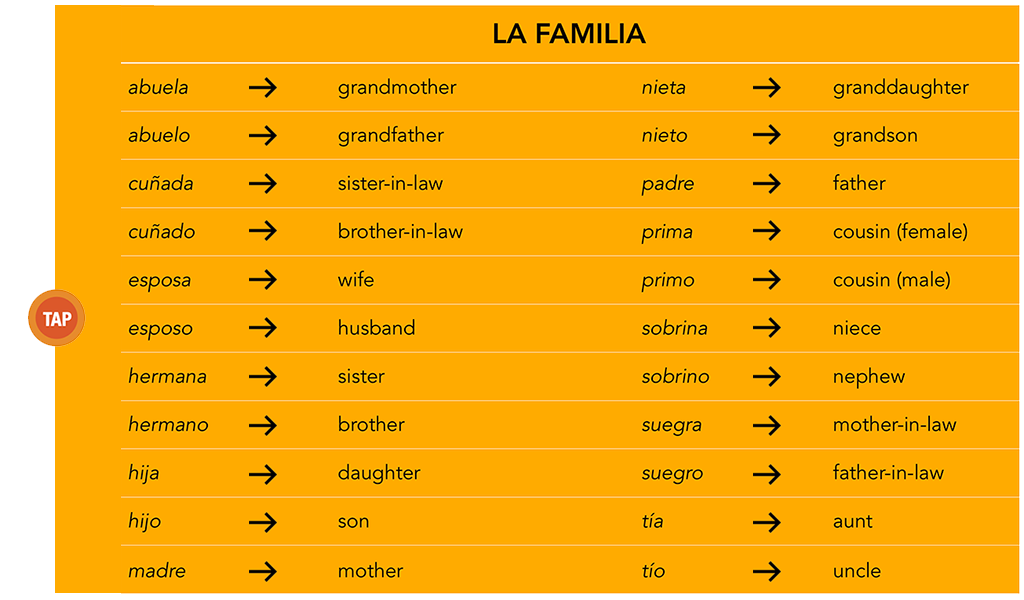
The following is a list of useful vocabulary related to the family:
33410
PRÁCTICA DE PRONUNCIACIÓN
z, l, ll
Here are some more consonants:
z
In most of the Spanish-speaking world, this consonant sounds like the “s” in “sailor.” In parts of Spain, it sounds like the “th” in “thin.” zapato, zona, lápiz, Zaragoza, azúcar, alzar, realizar, azul, azulejo
l
This consonant is pronounced just as in the English word “lost.” lindo, listo, luego, alto, leal, hotel, loco, lástima, Los Ángeles, líquido, limón
ll
This is another consonant that historically has been considered one letter in the alphabet. In most places in the Spanish speaking world, it is pronounced like the “y” in “yes.” In parts of Spain, it resembles the “lli” in “billion,” while in Argentina and Uruguay, it sounds like the “Zsa” in the name “Zsa-Zsa.” millón, relleno, callado, calle, valles