When you want to find out what someone is like, you could ask him or her:
Est-ce que vous êtes patient? (Are you patient?) Oui, je suis patient. (Yes, I am patient.) Non, je ne suis pas patient. (No, I am not patient.)
Est-ce que vous êtes charmant? (Are you charming?) Oui, je suis charmant. Non, je ne suis pas charmant.
Est-ce que vous êtes intéressant? (Are you interesting?) Oui, je suis intéressant. Non, je ne suis pas intéressant.
You can also ask someone to tell you what someone else is like. Here are some possible questions you might ask:
Est-ce que votre ami est prudent? (Is your friend careful?) Oui, mon ami est prudent. (Yes, my friend is careful.) Non, mon ami n’est pas prudent. (No, my friend is not careful.)
Comment est votre amie? (What is your friend like?) Mon amie est généreuse et charmante. (My friend is generous and charming.) Mon amie est intelligente. (My friend is smart.)
Most adjectives take an “e” at the end when referring to a female or to a “feminine” word.
Est-ce que votre père est strict? (Is your father strict?) Oui, mon père est strict. Non, mon père n’est pas strict.
Est-ce que ta mère est stricte? (Is your mother strict?) Oui, ma mère est stricte. Non, ma mère n’est pas stricte.
The adjectives used so far in this section should sound quite familiar to an English speaker (charmant, généreux, intelligent, normal, prudent, strict). It is because these words are cognates — they come from the same Latin roots — that they are so easily recognizable.
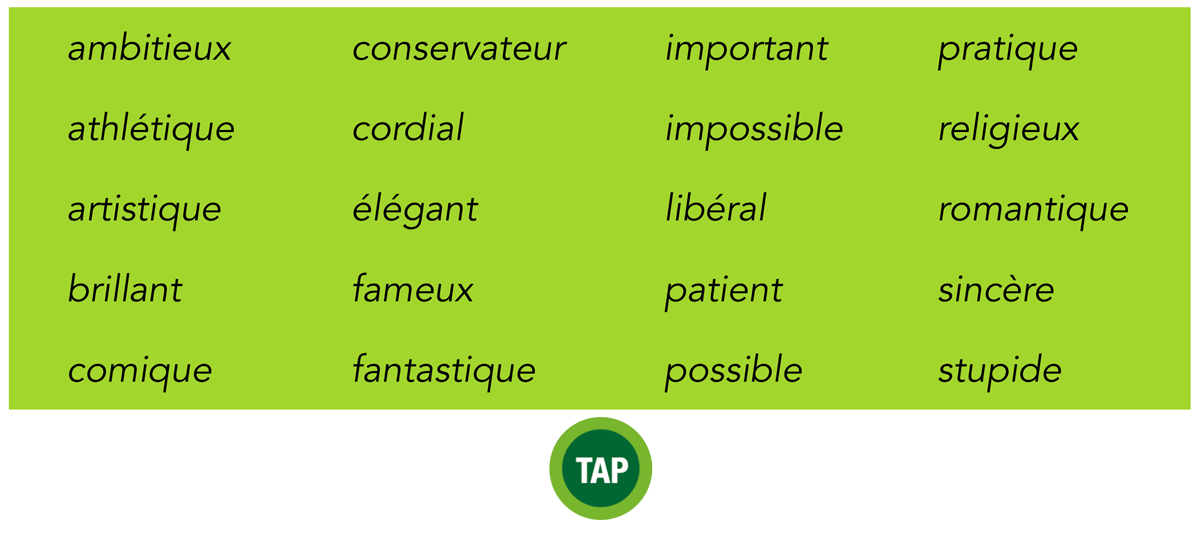
Here are some other French adjectives whose meanings you could probably guess instantly: